Finding my market opportunity required me to look beyond my own interests and investigate what is already available to consumers. As a consumer myself, I wanted to think about my own needs and what might be missing from my toolbox.
After examining the products already available to users at different skill levels, I figured there might be an opportunity to create something that could be a bit friendlier to beginners.
I began by researching three different areas of the digital content market: photo editing, website creation, and social media management.
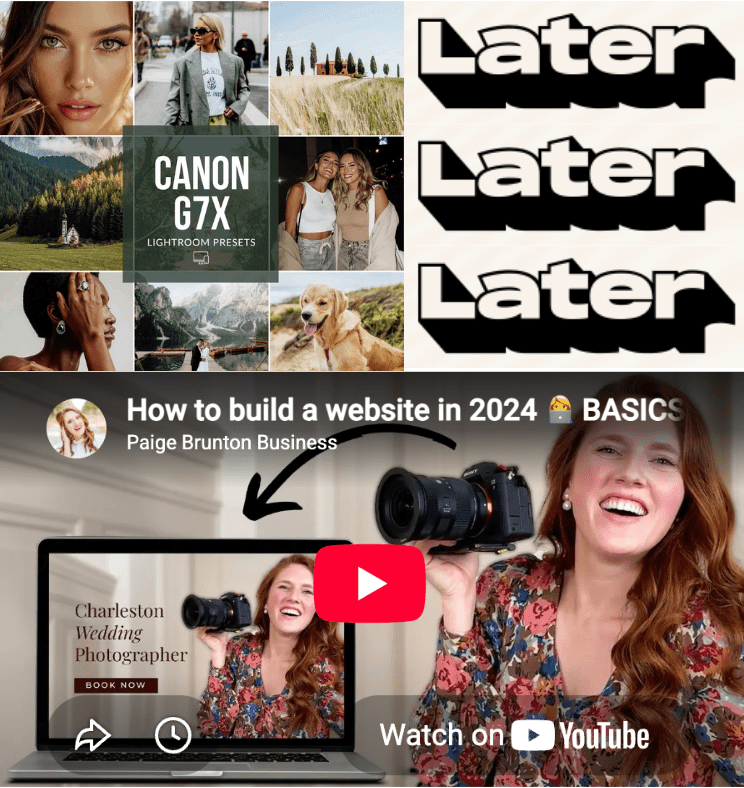
My first comparison was 123 Presets’ Canon G7X Lightroom presets. Presets demonstrate the demand for products that make content creation faster and help creators develop a consistent visual identity.
However, I realized that no one really taught me how to edit my photos. After years of messing around with Lightroom, I have gained a substantial amount of knowledge about how to edit photos depending on lighting, the person being photographed, and the overall vibe of the image.
While I am not the biggest fan of simply slapping a preset onto a photo without making adjustments, I understand that it can be an efficient way to edit an entire set of pictures. If I developed presets, I would include explanations of why I am increasing or decreasing contrast, exposure, warmth, and other settings. I would also create variations for different complexions and lighting conditions, making the product more inclusive and useful.
Next, I looked at Paige Brunton’s guide to building a website. Honestly, even working with WordPress can still confuse me sometimes. I am not a professional at managing websites, but I do love creating on multiple platforms.
Many people are in the same position: we have a vision for our website but struggle to execute it because we are unfamiliar with coding or the right tools. Therefore, creating a beginner-friendly guide centered around visual examples, tips, tricks, and shortcuts could be beneficial. Her guide was definitely a great example of what I would want to create.
Lastly, I explored Later, a social media management platform that helps users plan, schedule, and organize content. While its services show the value of keeping digital content organized in one place, there are already many platforms competing for attention and offering similar features.
My goal would be to create something more specific to small creators trying to establish themselves and fashion influencers who want to stay up to date with trends.
Ultimately, these three comparisons helped me recognize that I could take what I learned from each market and apply it to my very own fashion calendar. My pitch would bring together fashion weeks, collections, launches, trends, and other important industry moments in one organized and visually engaging space. My target audience would primarily be fashion-interested Gen Z and young adults, including aspiring creators, students, and emerging fashion professionals.
I am leaning towards developing the fashion calendar because it is the concept I am most interested in especially withe rise of fashion in digital media.
Although it has many moving parts, I see that as a strength because they can work together to create a more complete product. My next step is to research existing fashion calendars and determine what features would make mine stand out.

