By: AI
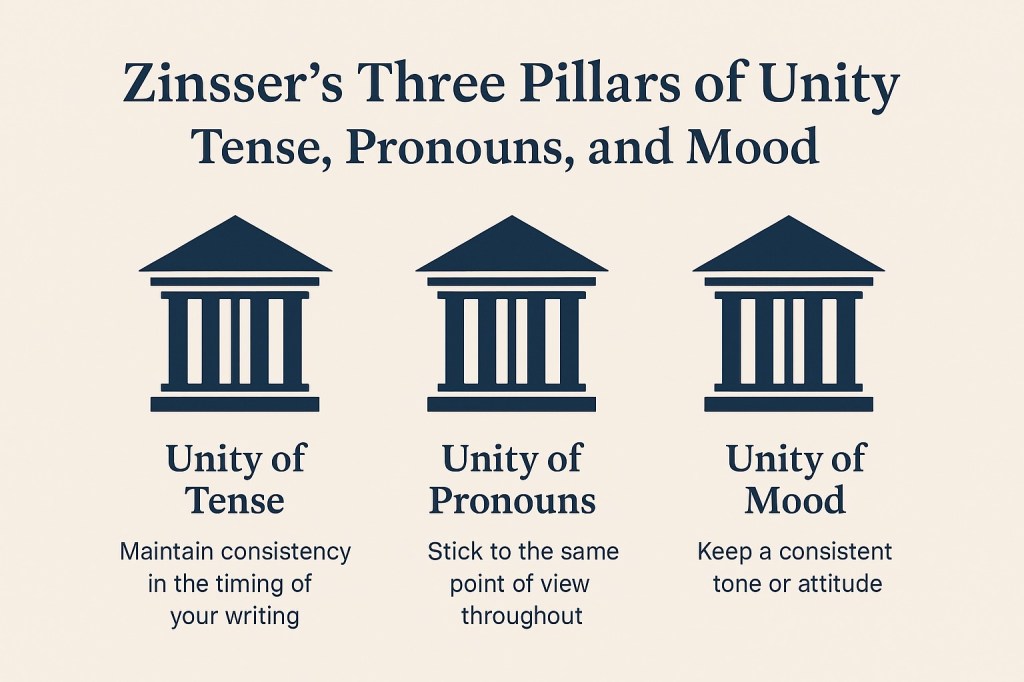
In On Writing Well, William Zinsser argues that clarity isn’t just about choosing the right words—it’s about holding your writing together with unity.
In Chapter 8, he breaks this idea into three practical elements every writer can control: tense, pronouns, and mood. Understanding these ideas can dramatically tighten your writing and make your message more trustworthy.
Unity of Tense: Pick a Time and Stay There
One of the quickest ways to confuse a reader is to bounce around in time without reason. Zinsser stresses the importance of choosing a tense—past, present, or future—and remaining consistent.
For example, if you start by describing an event in the past, shifting suddenly into the present moment can feel jarring unless you clearly signal why. A unified tense keeps your writing grounded and gives the reader a stable sense of when the action is happening. It’s a simple decision, but one that keeps your story or explanation anchored.
Unity of Pronouns: Decide Who’s Talking to Whom
Pronouns shape a reader’s relationship to the text. Are you writing as I? Are you addressing you? Are you speaking broadly in terms of we?
Switching pronouns midway—say, beginning with personal reflections and then jumping into general statements—weakens the connection you’ve built. Zinsser’s point is that readers follow the voice you establish early on.
If you decide to write from the first-person perspective, keep that consistency. If you prefer the distance of third person, stay there. The steadier the voice, the stronger the unity.
Unity of Mood: Tone Is a Commitment
Mood is the emotional quality or attitude behind your writing. It might be playful, serious, skeptical, optimistic—whatever suits the subject. Zinsser emphasizes that once you strike a tone, you should protect it.
A light, humorous approach loses power if you suddenly shift into formality. A thoughtful, reflective mood becomes confusing if it turns sarcastic halfway through. Consistent mood helps your audience know how to feel about what they’re reading, which builds trust and momentum.
The Bottom Line: Unity Makes Writing Feel Intentional
Zinsser’s message is not that writing must be rigid, but that it must be intentional. When you commit to a tense, a set of pronouns, and a consistent mood, you create a piece of writing that feels centered and confident.
Good writing doesn’t happen by accident. It happens when every choice—big or small—supports the direction you’ve chosen.
 XIOMIDIA